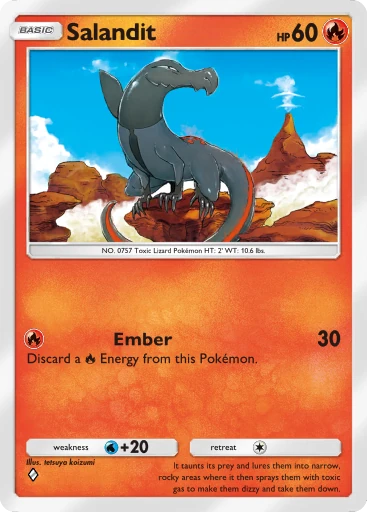
Salandit

Other versions of this card


Other cards of Salandit
About Salandit — Strengths / Weaknesses
+ Venoshock deals 10+ (10 base damage) for 1 energy — can gain BONUS damage when the attack's condition is met, up to about 50 damage.
+ It's a Basic Pokémon — can attack from turn one, no evolving needed.
- Weak to Water (+20 damage) — avoid facing that type's decks.
Salandit is a Common card from the Mythical Island set. Check its attacks, retreat cost and which pack it drops from below.
Attacks
If your opponent's Active Pokémon is Poisoned, this attack does 40 more damage.
Pokédex entry
It taunts its prey and lures them into narrow, rocky areas where it then sprays them with toxic gas to make them dizzy and take them down.
Which pack does this card drop from?
Three ways to get this card
Odds recalculated from the official per-slot pull-rate table for pack Mew: the chance of this rarity in each slot divided by the 32 cards of this rarity in that pack.
Want to know exactly how many packs you need to open to get Salandit?
Is Salandit played in any meta deck?
Salandit is not a core card in any of the 50 meta decks currently tracked. It is a filler card: Pack Points cost only 35, so do not burn packs hunting it — open packs for the rare slots and this one arrives on its own.
Same type in this set


Card name by language
Reading Salandit's stat block
Salandit is a Common Basic card from the Mythical Island set with 60 HP. Every STAT on this page comes straight from the card record; the expected pack count further down is a statistical estimate recomputed from the pull table, not a promise.
Its weakness is Water, which is the fastest way for an opponent to remove it in a straight trade, and its retreat cost is 1 — that is what you pay in energy to swap it out mid-turn, and it is the number people forget until the card is stranded in the active spot.
Its attacks:
- Venoshock — 10+ damage · cost Colorless — If your opponent's Active Pokémon is Poisoned, this attack does 40 more damage.
Read the energy costs together, not just the damage. A card with two attacks usually trades a cheap, weak opener for a pricier attack that does the real work, and the question that decides whether it belongs in a deck is whether you can actually pay for the big one on curve.
Which pack actually drops it

Rare cards are not spread evenly across a set. Each one is locked to specific packs, and opening the wrong pack from the right set means this card never shows up no matter how many you buy. Salandit drops from Mew. Odds are set per slot, not per card — and the slot layout differs from one pack type to another, so never carry one pack's formula over to another. The Mew pack gives 5 cards per opening — slot 1 is always Common · slot 2 is always Common · slot 3 is always Common · slot 4: 90.00% is Uncommon · slot 5: 60.00% is Uncommon. For Salandit that works out to 3.13% in slot 1 · 3.13% in slot 2 · 3.13% in slot 3, which is 9.08% for any single pack, or about 11 packs before you can expect to see one.
Three ways to own it
Pulling is only the first path, and it is the one that can betray you: 9.08% per pack means the expected 11 packs is an average, not a promise. The second path removes luck entirely. Every pack you open awards 5 Pack Points (an official in-game mechanic, not part of the drop-rate table) regardless of what comes out of it, and those points accumulate until you can redeem this exact card outright. Salandit costs 35 PP — no pulls, no gambling, just the count. The third path is trading, which spends Shinedust rather than Pack Points, and whether it is open to you depends entirely on the card's rarity. For Salandit: It can be traded, and it costs 0 Shinedust.
Evolution line and other printings
Salandit does not evolve from or into anything — it stands alone. Some Pokémon are also printed more than once — across different sets or promo drops, with different art, different rarity, and sometimes different attacks under the same name. Where other printings of this card exist, they are linked on this page, because the stats can differ even when the name matches.
Where this card stands on the ladder
Salandit is not a core card in any of the 50 meta decks currently tracked. It is a filler card: Pack Points cost only 35, so do not burn packs hunting it — open packs for the rare slots and this one arrives on its own. The meta deck table is recomputed from tournament data (play rate plus win/loss/tie record), not from anyone's opinion. A card missing from that table can still be beautiful and still be expensive to trade for, but it will not win games on its own — those are two different questions and this page answers them separately.
Frequently asked questions
Which pack should I open to get Salandit?
Salandit drops from Mew. Opening a different pack from the same set will not produce it, because pack variants inside one set carry completely different rare-card pools.
Roughly how many packs does it take to pull Salandit?
About 11 packs on average. That comes from the per-slot pull table rather than a single blended number: 3.13% in slot 1 · 3.13% in slot 2 · 3.13% in slot 3, which is 9.08% for any one pack. It is an expected value — a statistical estimate, not a guarantee: half of all players will need more.
Can I trade for Salandit instead of pulling it?
It can be traded, and it costs 0 Shinedust. Trading uses Shinedust, and whether a card is tradeable at all is fixed by its rarity tier — Immersive Rare and Crown Rare cards can never be traded under any circumstance, so for those two tiers Pack Points or a direct pull are the only ways in.